
The modern corporate landscape is completely flooded with data. Every click, transaction, supply chain movement, and customer review generates a digital footprint. However, raw data by itself is just an overhead cost—it only becomes a true asset when it is processed and translated into actionable insights.
This urgent organizational need has sparked an unprecedented demand for data professionals worldwide. If you are looking to enter this high-paying domain, you have likely run into two dominant terms: Business Analytics (BA) and Data Analytics (DA).
While they sound remarkably similar and frequently overlap, they represent two fundamentally different approaches to problem-solving, require distinct skill sets, and lead to different career paths.
Choosing the wrong direction can stall your career progress, while making the right choice will position you at the cutting edge of the technology sector. Let us break down the core mechanics of Business Analytics versus Data Analytics so you can confidently map your professional path.
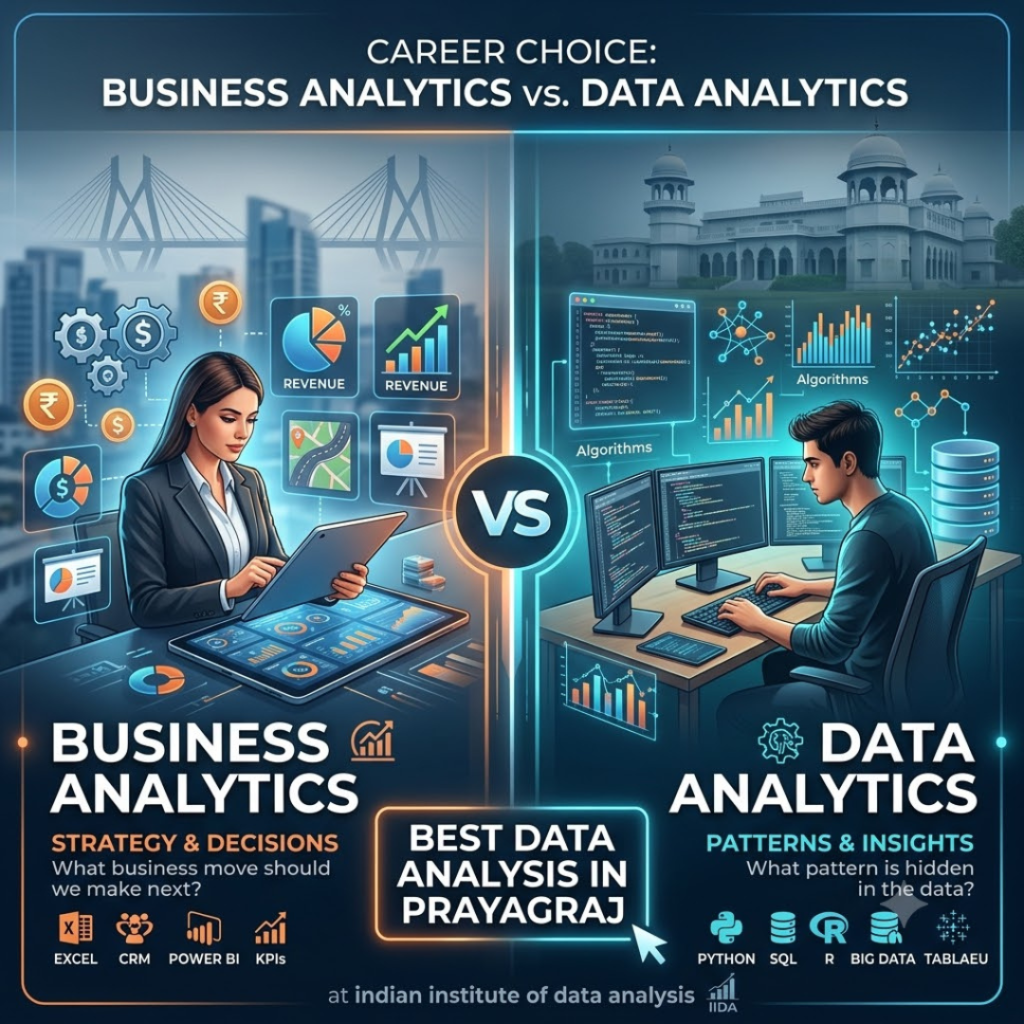
1. Defining the Core Concepts: What Sets Them Apart?
To understand how these fields diverge, it helps to examine the core questions each discipline tries to answer.
       [ RAW CORPORATE DATA ]
                 │
        ┌────────┴────────┐
        ▼                 ▼
┌───────────────┐ ┌───────────────┐
│ Data Analyst  │ │ Bus. Analyst  │
└───────┬───────┘ └───────┬───────┘
        │                 │
        ▼                 ▼
"What pattern is  "What business
 hidden here?"     move should we
                  make next?"
What is Data Analytics?
Data Analytics is the technical process of exploring, cleaning, transforming, and modeling raw data to discover hidden patterns, establish correlations, and extract objective insights.
Data analysts are the gatekeepers of raw information. They take chaotic, unstructured datasets and convert them into organized, structured formats. Their primary objective is to uncover the absolute truth of what happened in the past and what is currently happening within a system.
https://ritikinsight.com/wp-admin/post.php?post=999&action=edit
What is Business Analytics?
Business Analytics is the practice of using data-driven insights to make strategic corporate decisions, optimize operations, and solve business challenges.
Business analysts act as the bridge between technical data architecture and executive leadership. They do not get bogged down trying to optimize code or configure databases; instead, they take the findings provided by data systems and use them to answer critical operational questions: How can we decrease customer churn by 12% next quarter? Which supply chain route minimizes operational overhead?
2. Technical Capabilities vs. Strategic Implementations
The easiest way to differentiate between these two careers is to look at their day-to-day operations, the toolsets they use, and their primary responsibilities.
| Feature / Dimension | Data Analytics | Business Analytics |
| Primary Goal | Discover anomalies, build data pipelines, and extract technical insights from raw numbers. | Solve specific business puzzles, improve ROI, and direct corporate strategy. |
| Core Skill Set | Advanced programming, statistical mathematics, and database management. | Market analysis, financial forecasting, communication, and project management. |
| Primary Toolset | Python, R, SQL, Hadoop, Spark, Tableau, and Power BI. | Advanced Excel, SAS, Jira, Miro, Power BI, and CRM systems. |
| Working Environment | Deep focus on data architectures, statistical modeling, and code engineering. | Collaborative role involving stakeholder meetings, presentations, and product roadmaps. |
| Nature of Data | Works with structured, semi-structured, and massive unstructured datasets. | Primarily focuses on structured operational, financial, and market data. |
The Data Analyst’s Workflow
Imagine an e-commerce giant facing a sudden drop in application performance. A Data Analyst will write complex SQL queries to pull server logs, use Python scripts to clean null values, run statistical regression analyses to isolate variables, and build an interactive dashboard to show exactly when and where the latency spikes occur. They deliver a clear, technical diagnosis of the operational reality.
The Business Analyst’s Workflow
The Business Analyst takes that performance dashboard and looks at it through a financial lens. They calculate how much revenue was lost during those latency spikes, evaluate whether migrating to cloud servers will deliver a better return on investment (ROI), and present a concrete strategic roadmap to executive stakeholders recommending an infrastructure upgrade.
3. Educational Pathways and Career Trajectories
Because both professions require unique skill sets, their educational trajectories look quite different.
Landing a Role in Data Analytics
If you lean toward Data Analytics, your training must be highly technical. You need to master the foundational elements of programming, get comfortable with database systems, and learn data visualization frameworks.
Because the field is growing so fast, traditional degrees are no longer the only way in. Enrolling in a specialized coaching institute can rapidly bridge the gap between academic theory and practical execution. For instance, if you are looking for localized, hands-on training, finding the program that offers. will give you direct access to live projects, database sandbox environments, and structured mentorship tailored to local and remote job markets.
Landing a Role in Business Analytics
For Business Analytics, your path will mix foundational data literacy with deep business training. Many business analysts come from corporate administration, finance, or management backgrounds and pick up analytical tools later. Your focus should be on learning how to read financial models, mastering Agile project frameworks, and developing top-tier data storytelling skills.
4. Which Career Path Aligns with Your Strengths?
Neither path is objectively superior to the other; your choice should depend on your natural analytical style and what kind of day-to-day work keeps you engaged.
YOUR IDEAL CAREER MATCH

Do you love coding, math, and discovering hidden patterns?
  └── YES ──> Choose Data Analytics 📊

Do you love strategy, communication, and solving business problems?
  └── YES ──> Choose Business Analytics 📈
Choose Data Analytics if:
- You enjoy writing code, building algorithms, and tinkering with database structures.
- You love the challenge of taking messy, chaotic data and turning it into clean, orderly systems.
- You prefer independent, focused technical problem-solving over constant corporate meetings and presentations.
Choose Business Analytics if:
- You are deeply fascinated by business models, market economics, and organizational strategy.
- You love public speaking, translating technical concepts into plain English, and managing cross-functional teams.
- You want to see your insights directly shape company policy, product rollouts, and financial decisions.
5. Elevate Your Analytics Journey with Local Expertise
The data landscape across Uttar Pradesh is undergoing a massive shift. Cities like Prayagraj are rapidly changing from traditional educational centers into modern technological launching pads. With the expansion of digital infrastructure and remote work opportunities across the state, local businesses and global agencies alike are hunting for skilled professionals who can decipher complex data.
If you want to capitalize on this boom, relying entirely on self-study can leave you outpaced by the competition. You need a structured, industry-aligned learning path.
At the indian institute of data analysis, we offer an immersive, project-driven training curriculum specifically designed to build these high-demand skills. Whether your goal is to master complex Python pipelines as a Data Analyst or command executive boardrooms as a Business Analyst, our certified courses give you the practical exposure, portfolio development, and placement assistance you need to stand out.
The digital economy runs entirely on data. Stop guessing your next career move—join the program recognized for delivering the. today. Attend a free demo session and start transforming raw data into your professional success story.